0%

Loading

João FerrazPereira

Networks and Computer Systems student in Porto, heading into cybersecurity: vulnerability analysis, OSINT and web pentesting.

Scroll to explore

About

I would rather have five write-ups I can defend line by line than ten certification badges.

I am doing the CTeSP in Networks and Computer Systems at ISPGAYA, after a vocational degree in Information Systems Technologies at Colégio de Gaia. The goal is cybersecurity, built on networks, Linux and web development. I build things to understand them: a self-hosted homelab and a research blog with signed commits.

Porto, Portugal · Native Portuguese, advanced English

Studying now

  • Linux administration and network protocols
  • Risk management, cryptography, IAM and incident response
  • Python and Pascal, the languages of ethical hacking (self-taught)
6
published projects

Frontal lobe

Knowing how to do

To me, doing is deciding and then building. I pick a real problem, design the solution, and only count it as understood once it works outside my head. I break it, fix it, and what stays is what I learned.

Proof

Projects

Everything here is public and checkable. Ordered from closest to cybersecurity to furthest.

Detects and removes malware, tunes the PC for gaming and handles maintenance, from a repair USB stick.

Portable for Windows 10 and 11, no install. Three modules: Nerd'O (detection and removal of miners, trojans and other malware, in seven steps with explicit authorisation, quarantine and undo), Game Mode (FPS Optimizer, RAM Lover and MegaTweaker, every change reversible) and PitStop (diagnostics, app and driver updates, first setup). Nothing changes without an authorised plan, there is no network or telemetry, and everything read from the system is treated as data.

  1. ContextRead-only
  2. Scan
  3. Diagnosis
  4. Explicit authorisationYou authorise
  5. Quarantine and restore pointChanges, with undo
  6. New scan and Defender
  7. Final report

Every finding gets a state

  • OK
  • CONFERIR
  • SUSPEITO
  • NAO_VERIFICADO
The 7 phases of ZeroBirus: read-only until you authorise, only then it changes. No network, no telemetry. Everything read from the system is treated as data.

Roadmap

  • Nerd'O: detection, quarantine and undo (Alpha 1.0)
  • 5-level risk table (in code)
  • Game Mode: FPS Optimizer, RAM Lover, MegaTweaker (in code)
  • PitStop: BigDiag, AllUp, FirstSetup, AllDrivers (in code)
  • Manual testing on real Windows (in progress)
  • Release 1.1: MSI installer, code signing, false-positive submission to Microsoft
Status
Alpha 1.0 released · version with Game Mode and PitStop in development (Windows CI green, real-PC testing in progress) · MIT
Stack
  • Python
  • PySide6
  • PyInstaller
  • winget
  • uv
  • ruff
  • mypy
  • pyright
  • pytest
  • Windows CI

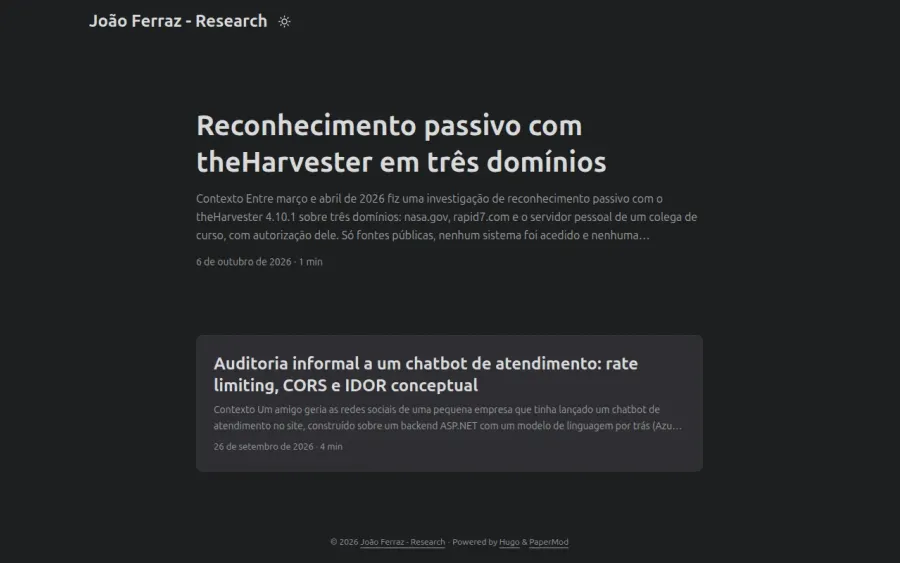
Technical write-ups on pentesting, API analysis and LLM security, with GPG-signed commits.

Every commit carries the Verified badge on GitHub. Hugo with the PaperMod theme, static HTML served by Nginx on a Lenovo laptop running Ubuntu Server, Let's Encrypt with automatic renewal and DuckDNS. Posts: an informal audit of a support chatbot (rate limiting, CORS, conceptual IDOR, findings reported to the owner) and passive recon with theHarvester.

Screenshot of the live site
Status
Online · signed commits
Stack
  • Hugo
  • Nginx
  • GPG
  • Let's Encrypt
  • Ubuntu Server

Cryptography from a book to demos that run in the browser, to understand how it fails.

Five phases: symmetric (AES-GCM with the Web Crypto API), asymmetric, hybrid, OpenPGP, and what goes wrong (repeated IV, ECB mode, weak passwords, short keys). The repo includes the corrections I made to my own summary and says who wrote what: I used Claude to review the summary and write phase 1.

Screenshot of the live site
Status
Phase 1 of 5 done · MIT
Stack
  • JavaScript
  • Web Crypto API
  • OpenPGP.js
  • HTML

A Swiss army knife for files, open to everyone with no sign-up: convert, corrupt and repair files, with workers isolated by network.

An image, audio, video and document converter, plus a file Corruptor and Repairer, all public with no login; and a music downloader (mp3 with metadata and cover art) reserved for the admin. Security is the focus: the web service never interprets files, the offline worker runs with no network, the music worker can only reach a Squid proxy that blocks the LAN, and every container runs non-root with a read-only filesystem and cap_drop ALL. Uploads are checked by magic bytes and deleted automatically, with per-IP request and queue limits, argon2 admin login, CSRF, IP lockout and optional TOTP. Runs on Docker Compose behind Caddy, with HTTPS and DuckDNS.

Status
Online · under active development
Stack
  • Python
  • FastAPI
  • HTMX
  • SQLite
  • Docker Compose
  • Caddy
  • Squid
  • ffmpeg

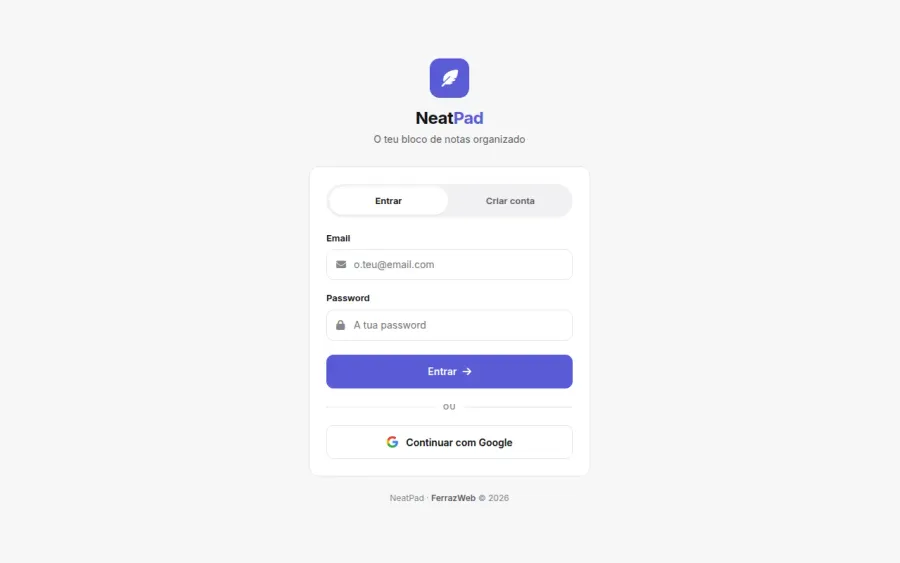
A technical notepad for people learning and working in IT, installable on iOS, Android, Windows and Linux.

Categories with icon, colour and type (notes, tasks, courses, notebooks), a Notion-inspired rich-text editor, version history with autosave, sub-tasks, light and dark themes, Firebase login and isolated per-user spaces. PHP and MySQL backend in Docker behind Nginx, with Let's Encrypt SSL. Part of the FerrazWeb ecosystem, with FerrazWeb and SCII still in development.

Screenshot of the sign-in screen (the app is private per user)
Status
Online · CC BY-NC-ND 4.0
Stack
  • PHP
  • MySQL
  • JavaScript
  • Docker
  • Nginx
  • Firebase Auth
  • PWA

Parietal lobe

Knowing how to connect

Networks, Linux, code and web do not live apart. I understand a system when I can connect the pieces end to end, from the packet on the wire to the screen of the person using it.

Proof

Skills

Security

  • Cibersegurança
  • Ethical hacking
  • OSINT
  • SOCMINT
  • Google Dorking
  • theHarvester
  • Digital forensics

Systems

  • Linux
  • Ubuntu Server
  • Docker
  • Nginx
  • Tailscale
  • Fail2ban
  • UFW

Code

  • Python
  • Java
  • JavaScript
  • PHP
  • HTML5
  • CSS3
  • Pascal

Web

  • Web development
  • Front-end
  • SEO
  • WordPress
  • MySQL
  • MariaDB

Temporal lobe

Knowing how to learn

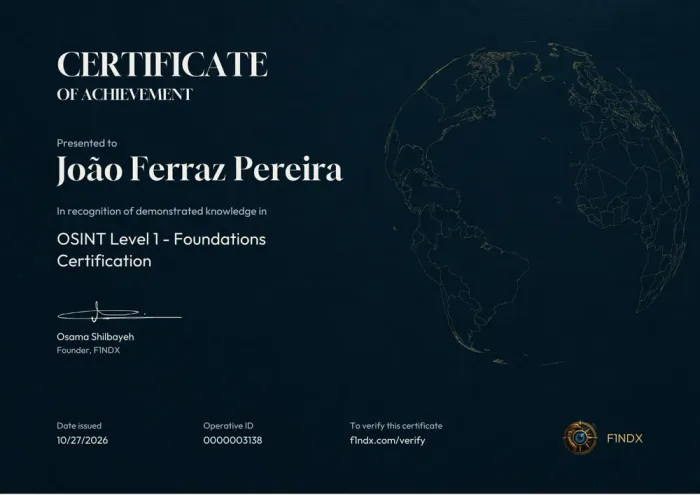
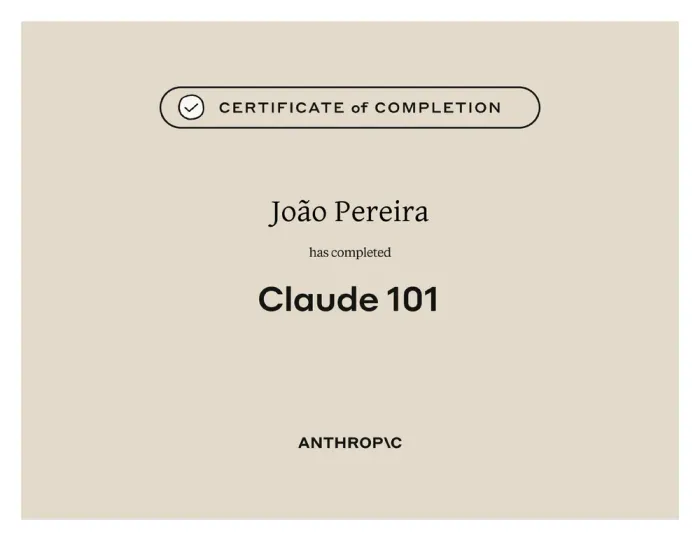
Learning is building memory with method: school, a degree, a 400-hour internship and certificates I can show. Each stage rests on the last, and I say plainly what has no certificate.

Proof

Path

From vocational school to higher education, with an internship in between.

Sep 2025 – Jun 2027

CTeSP in Networks and Computer Systems

ISPGAYA · EQF 5 · 120 ECTS · ongoing

Information security management (NIST RMF and CSF, ISO 27001), network security, cryptography and PKI, VPNs and IPSec, identity and access management, incident response, Linux administration, Java and databases.

  • NIST
  • ISO 27001
  • PKI
  • IAM
  • Linux

Jun 2024 – May 2025

Web Developer and Helpdesk (internship)

ISPGAYA · Vila Nova de Gaia · 400 h · grade 19/20

I built two systems from scratch with authentication, a database and a responsive interface: a platform for CFBT-PT, a training centre on indoor fire behaviour, and a queue system for CIISP's front desk, with a kiosk, backoffice and live display. On the helpdesk, internal technical support. I used AI tools to speed up development.

  • PHP
  • MySQL
  • JavaScript
  • TailwindCSS
  • HTML5

Sep 2022 – Jul 2025

Information Systems Technologies

Colégio de Gaia · EQF 4 · vocational secondary

Web development (HTML, CSS, JavaScript, PHP), relational databases (MariaDB, MySQL) and networking basics with hands-on labs on the OSI model.

  • HTML
  • CSS
  • PHP
  • MariaDB
  • OSI

Certificates

Few, each with what I learned. The ones without a certificate say so.

Windows Fundamentals, NetworkChuck Academy (Jan 2026): course completed, no certificate.

Occipital lobe

Knowing how to observe

In security, seeing well comes before acting. OSINT is passive recon, public sources only, and the rule is to document what you see without touching anything.

Proof

Technical Reports

What you can learn about organisations using only public sources, with theHarvester 4.10.1.

Three targets: nasa.gov, rapid7.com and a friend's personal server, with their permission. Findings: exposed NASA emails and internal subdomains, the real IPs of Rapid7's InsightVM scanners, and the real IP of a home server despite Cloudflare. Includes methodology, comparative analysis and ethical considerations.

Public sourcestheHarvester 4.10.1
  • nasa.gov

    Exposed emails and internal subdomains.

  • rapid7.com

    Real IPs of the InsightVM scanners.

  • A friend's server

    Real IP found despite Cloudflare.

    with the owner's permission

Three targets, one tool, public sources only. 23 pages with methodology, comparative analysis and ethics.
Status
Mar. to Apr. 2026 · linked to my ORCID
Stack
  • theHarvester
  • OSINT
  • Linux

Every report I write is collected here. For more detail, write-ups and methodology, head to the blog.

Cerebellum

Knowing how to keep running

Building is half the job, keeping it up is the other half. In my homelab, services, DNS, firewall and alerts all have to work at once, every day.

Proof

Homelab

A Lenovo laptop running Ubuntu Server, serving this kind of work for real instead of only describing it.

Speech area

Knowing how to explain

I only really understand what I can explain. That is why I write write-ups, sign my commits and leave a simple way to talk to me.

Proof

Contact

Pick a subject and write. I do not show my email or phone number on this site. If you need the number, ask for it in the form and I will reply.

Your message is used only to reply to you. It is sent by email through Resend, and the anti-spam check uses Cloudflare Turnstile (which sees your IP). The site stores nothing else; to have your data deleted, just ask through this form.

Also find me on

Give me the context. The more concrete, the faster I reply.